

I once heard a quote that sticks with me to this day. I’m really paraphrasing, but it goes something like:
“Knowing how to code today is like knowing how to read five hundred years ago. Those who learn it will get ahead”.
Yeah, it was probably more eloquent than that, though.

But the point is, technology is advancing, and it’s advancing fast. The world is practically becoming digitized, and everyday we’re surrounded by high-tech devices, whether it’s our smartphones, computers, televisions, watches, coffee machines, refrigerators, and honestly probably any other appliance in your home. A hundred years ago, in 1920, cars were quite rudimentary and electricity still wasn’t fully common in the world yet.
But today, everything is extremely fast paced, and we rely on technology for everything. It provides so much convenience (especially with the internet) and is a huge source of short-term, instantaneous gratification.
And the language of all of this technology happens to be computer science and programming. Your Facebook exists thanks to the efforts of full-stack developers and data sciences utilizing their talents in Silicon Valley. Elon Musk’s self-driving cars are the result of coders putting in hours and hours of work.
But in essence, what is coding, though, like without any technical terms? Very simply, it’s a way of making our lives easier, by making a computer do something for us. Because of this, coding is basically utilized everywhere in addition to the tech industry, especially the sciences. But you can also see it in the financial sector, some random startup company, as well as back office of bakery where a developer creates a website for that shop as well as organize all of the customer data using Python.
Everyone should code, whether you’re an astrophysics student, a business major, the owner of a sandwich shop, a musician, or even a triple major in psychology, art history, and Slavic history. Scientists at NASA need programming to launch the Mars Rover. A photographer may code to automate image processing. A content creator on Instagram or YouTube may write a Python script that uploads scheduled posts for them each week. Coding is everywhere, and if you just think about it enough, anyone can see a benefit from it.
For example, any math student knows that there’s a lot of graphing and visualization that you have to do. Back in the day of great mathematicians and physicists, everything was done on chalkboard and paper. But using Python today, you can use special packages such as Numpy or Matplotlib to create 3D representation of multivariable functions that are clear and honestly quite beautiful.
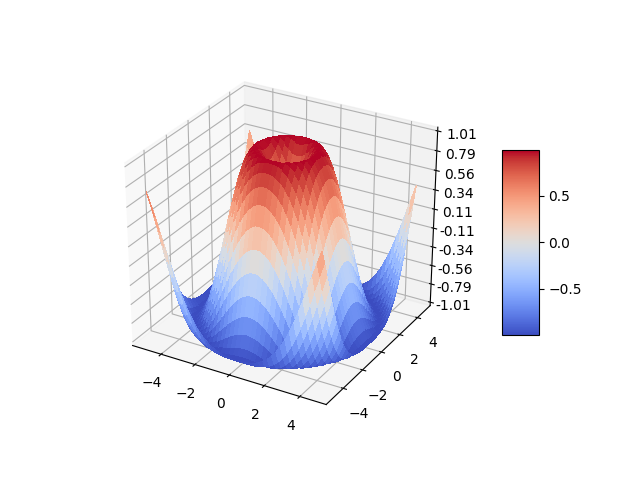
Or let’s say you’re a cognitive science and psychology student interested in the way AI develops to do certain tasks in comparison to the development of the complex human mind. Well, there’s a whole branch of coding for that, called machine learning. So yes, even non “STEM” students can see advantages to coding. And remember, you don’t need to be a math genius to know how to code. The point of methods in coding is so that the computer does the work for you, so you just have to guide it along.
Even business students may benefit from coding. Want the daily report of the stock market? You can automate apps to email you the market status each day to email you, using data science. And forget using spreadsheets anymore, using two lines of code you can efficiently manipulate columns filled with thousands of rows of data.
Musicians may utilize the benefits of programming, too. There is a science behind the idea of sounds, which permeate in waves. With the right software, the musician may be able to take a closer, analytical look at their work by calculating things like the frequency and amplitude of certain signals.
The point of all of this though, is to drive home the idea that coding is not a scary, foreign process that only geniuses can do. All coding languages are in English and are very readable. For example, say we want to do a task in Python, such as print all numbers from 1-10. This is what we would tell the computer:
for number in range(11):
    print(number)
Translated to everyday speech, this says “For the numbers in the range of 1 through 11 but not including 11, show me each number.”
Not so bad, right? I have been coding for a while now, but whenever I struggle I try to keep things simple, and ask, “Okay, what do I want the computer to do for me, and what are the logical steps to get there?”
The reason humans invented calculators is to simply make things more convenient and so that abacuses wouldn’t have to be used anymore. And the reason humans developed coding is to make the world run more efficiently. This is why the field of programming is so versatile, as it can be utilized in so many different places. Because of this, I don’t think coding should be regarded as intimidating; it’s not cut and dry topics like theoretical physics or pure mathematics that have more restrictions and rules. Coding is a language that can permeate throughout a technologically advanced civilization, which is what Earth happens to be.
Resources to learn coding:
YouTube (search “Intro to [coding language]”)
Follow this blog for more posts about science and technology!
Subscribe to Astrophysics Feed:
Recent Posts
- Studying Astrophysics Amidst a Global Pandemic
- The Importance of Astrophysics in a Non-STEM Context
- Why everyone can code (and should)
- Does School Name Matter for Astrophysics?
- Basics of Astrophysics #2 – The Earth and Moon
Social Media

 Astrophysics Feed